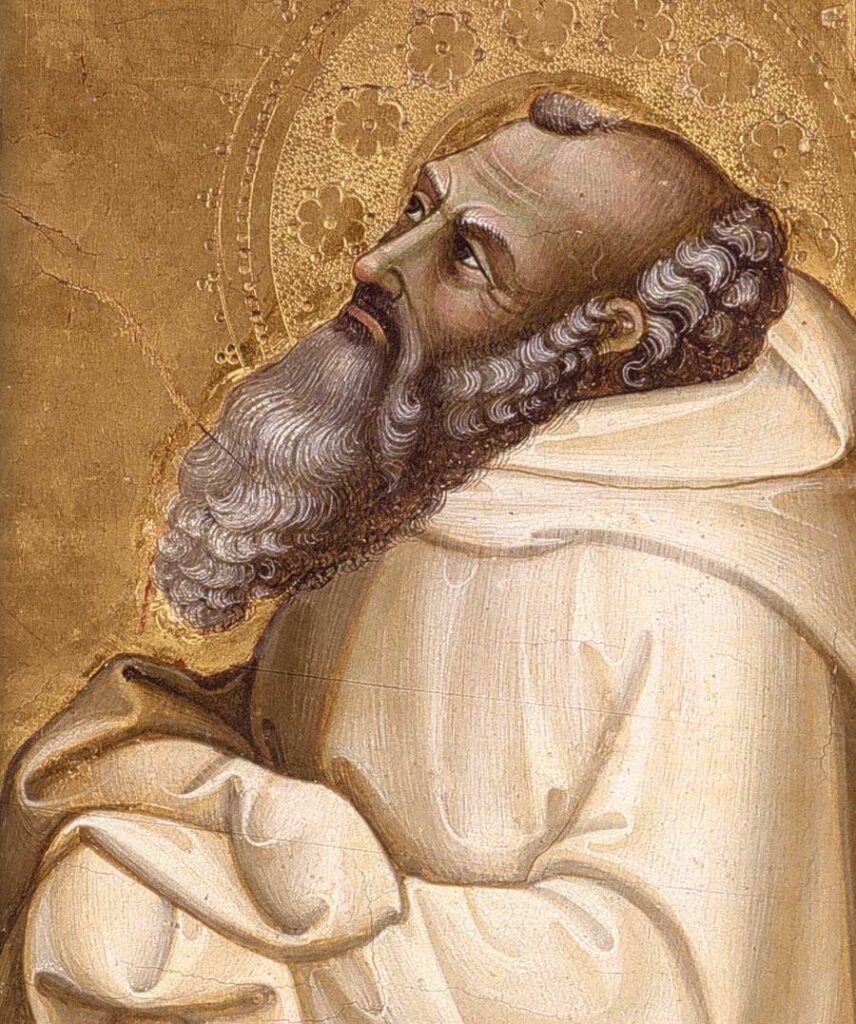
Lorenzo Monaco
Lorenzo Monaco (‘Lawrence the Monk’) was the most important painter in Florence in the first two decades of the fifteenth century. He was born, possibly in Siena, in the late 1360s or early 1370s, and his name as a layman was Piero di Giovanni. He took the name of Lorenzo when he took vows at the Camaldolese monastery of Santa Maria degli Angeli at Florence in 1391. He was ordained deacon in 1396. By March 1402 he was living outside the monastery in the parish of San Bartolo del Corso, and in the same year he enrolled in the Arte dei Medici e Speziale under his lay name. In 1415 he bought a house opposite San Maria Nuova, where he lived until his death. He is last documented on 7 August 1422 and may have died on 24 May 1424.
Few other facts are known about his life. He is sometimes assumed to have trained as a book painter in the monastic scriptorium, and many examples of his work as a miniaturist have come down to us. Another theory is that he trained in the workshop of Agnolo Gaddi. Some predella panels (three in the Louvre) from a polyptych produced in Agnolo Gaddi’s shop in 1387-88 have been attributed to Lorenzo as perhaps his earliest surviving works.
An altarpiece, now in the Accademia at Florence, was commissioned by 1407 for the monastery of Monte Oliveto and completed in 1410. The great Coronation of the Virgin, painted for Lorenzo’s own monastery of Santa Maria degli Angeli and now in the Uffizi, is signed and dated February 1413 (1414 in the modern calendar). A similar altarpiece of the Coronation of the Virgin was painted, probably between 1407 and 1409, for another Camaldolese monastery, San Benedetto fuori della Porta a Pinti. Most of it, reassembled from fragments, is now in the National Gallery, London. Some frescoes in the church of Santa Trinita are mentioned by Vasari. On the basis of these few authenticated works, a great many attributions have been made. The status of some attributed early pictures is unresolved and the question of workshop participation is often vexed; but Lorenzo Monaco’s own output was undoubtedly considerable.
Lorenzo Monaco’s early works (large and small altarpieces with flat figures, gold backgrounds and little sense of spatial depth) are in the late Giottesque tradition of Agnolo Gaddi and Spinello Aretino. His later works show the influence of the International Gothic style. Figures tend to become very elongated, with elegant, swaying poses, and are wrapped in voluminous draperies with sweeping folds. Narrative scenes have a fairy-tale quality. Compositional ideas and motifs were borrowed from (or shared with) the sculptor Lorenzo Ghiberti.
Altenburg. Lindenau Museum.
Flight into Egypt. Wood, 20 x 32.
The Holy Family are accompanied by two midwives (who are not mentioned in the canonical Gospels but appear in several apocryphal ones). This well-preserved little quatrefoil panel came from the predella of an altarpiece that has not yet been firmly identified. It is usually dated shortly before 1410. Two other panels from the same predella are in the Courtauld Institute Galleries, London, and a fourth is in the Metropolitan Museum, New York. Acquired by Bernhard von Lindenau by 1848. Originally ascribed to the Sienese School, it was recognised as a work of Lorenzo Monaco by Crowe and Cavalcaselle (1864).
Crucifixion with SS. Francis, Benedict and Romuald. Wood, 56 x 42.
The kneeling St Francis embraces the base of the cross, while St Benedict and St Romuald sit at the sides in white Camaldolese habits. Tiny angels collect the blood that drips from the wounds in Christ’s hands and side. This penitential panel was acquired in Rome in 1848 as a work of Spinello Aretino. It is almost perfectly preserved.
Amsterdam. Rijksmuseum.
St Jerome in his Study. Wood, 23 x 18.
The scholarly Jerome stands in his study surrounded by books. Normally shown as a cardinal, he wears a monk’s black habit. (What appears to be the edge of his red cardinal’s hat can just be glimpsed, however, hanging behind the bookshelf on the right.) The lion sits looking up at him, raising his bleeding paw to have the thorn removed.The tiny panel was probably half of a portable diptych; the other half has been identified as the Madonna of Humility in the Thorvaldsen Museum, Copenhagen. Probably late (around 1420).
First recorded in 1872 (with an attribution to the School of Murano) in the famous Costabili collection at Ferrara. It was later owned by the Berlin economist Richard von Kaufmann (from about 1885) and then the Amsterdam surgeon Otto Lanz (from 1917). Lanz’s extensive collection of early Italian art was sold by his widow to Adolf Hitler in 1941 but returned to the Netherlands after the War.
St Francis receiving the Stigmata. Wood, 87 x 62.
St Francis, kneeling in prayer in the rocky landscape at La Verna, experiences his vision of the crucified Christ, who appears with the six wings of a seraph. Fine golden rays indicate the impression of Christ’s stigmata – the wounds from the nails and spear – on St Francis’s hands, feet and side. The panel was probably the left wing of a triptych, which had the Funeral of St Francis in the Galleria Pallavicini, Rome, as the right wing. The central panel may have been the Crucifixion with the Virgin, St John and St Francis in the Bandini Museum at Fiesole.
Generally considered a late work of Lorenzo Monaco (though Eisenberg (1989) assigns it to his workshop). Like the Saint Jerome, the panel came from the collection of Otto Lanz, which was purchased for Hitler’s Führermuseum at Linz but recovered after the War.
Assisi. Basilica of San Francesco. Mason Perkins Collection.
Madonna of Humility. Wood, 84 x 59.
The Virgin is seated on a marble dais with one knee folded beneath her. The Christ Child stands on her other, raised knee, making a gesture of benediction with his right hand. Two small adoring angels kneel on floating clouds. The panel is one of the best preserved works in the Mason Perkins Collection. It has often been ascribed to Lorenzo Monaco’s workshop, but some more recent art historians (including Federico Zeri in his 1988 catalogue of the Mason Perkins Collection) have argued for an attribution to the master himself as a very early work.
Avignon. Musée du Petit Palais.
Triptych. Wood, 162 x 150.
The centre panel shows St Lawrence enthroned, dressed as a deacon, holding a book, martyr’s palm and chalice and with his feet on a gridiron. The saint in the left-hand panel has been called Agnes and Catherine, but is more usually identified as Ansanus (a patron saint of Siena). The saint in the right-hand panel is identified by the dragon as Margaret of Antioch. In the pinnacles are small medallions representing the Redeemer Blessing and the Angel and Virgin of the Annunciation. The inscription includes the date 1407 (now partly effaced).
The triptych is from the church of San Salvatore in Valle at Monteloro (a village near Pontassieve, east of Florence). It was acquired in 1861 with the Campana collection as a work of Taddeo Gaddi, but the ‘style of Lorenzo’ was recognised by Crowe and Cavalcaselle (1864). The execution has usually been ascribed to the artist’s workshop or to a follower. Three predella panels in the Vatican Pinacoteca depict the martyrdoms of the saints represented in the triptych.
Baltimore. Walters Art Museum.
Crucifixion of St Peter. Wood, 25 x 41.
According to an ancient tradition (dating back at least as far as the late second-century apocryphal Acts of Peter), St Peter asked to be crucified upside down because he felt he was unworthy of being treated like Christ. Workmen nail his hands to the cross, and a Roman in a toga holding a baton and a soldier with a shield stand on the right. The curious pyramidal structure in the left background is the Meta Romuli, a tomb monument (demolished by the early sixteenth century) that stood near the site of St Peter’s martyrdom.
The painting was part of a predella, which also included panels in Berlin (Nativity), Leicester (John the Baptist departing for the Wilderness), Princeton (Beheading of St Paul) and a private collection (St Jerome in the Wilderness). The Baltimore panel stood beneath a panel of St Peter in the Accademia, Florence. The Accademia also houses three other panels of full-length saints from the sides of the altarpiece, which probably came from the church of Santa Maria del Carmine. The centre panel of the altarpiece, representing the Madonna Enthroned, is at Toledo (Ohio).
Acquired (with an attribution to Pietro Cavallini) by Henry Walters in 1902 with the vast collection (1,700 items) amassed by the Papal Almoner Don Marcello Massarenti.
Bergamo. Accademia Carrara.
Man of Sorrows. Wood, 34 x 24.
The dead Christ is shown from the waist up, standing in a tomb of pink marble, with a black cross behind him. The figure of Christ resembles the Man of Sorrows of 1404 in the Accademia, Florence. The small panel has been cut down on all sides. Its original purpose is uncertain: it could have been half a diptych (the other half would probably have been a Madonna and Child), a panel from a polyptych or the door of a tabernacle. Bequeathed with the collection of the art historian Giovanni Morelli in 1891.
Berlin. Gemäldgalerie.
Nativity. Wood, 25 x 60.
The centre panel of a predella. It stood beneath the Madonna Enthroned at Toledo (Ohio). Other panels from the predella, which stood beneath the four panels of standing saints in Florence (Accademia), are in the museums at Baltimore, Leicester and Princeton; one is still in private hands (sold at Sotheby’s, London, in December 2005). Previously ascribed to the School of Agnolo Gaddi. An attribution to Lorenzo Monaco was first suggested in 1939 (by Sandberg-Vavalà in Art in America). Acquired by Friedrich Wilhelm III of Prussia in 1821 with the huge collection of the English merchant Edward Solly.
Martyrdom of St Catherine; Last Supper. Wood, 44 x 58 and 47 x 143.
Two panels from a predella. The Martyrdom of St Catherine was on the left, beneath a standing figure of St Catherine (Accademia, Florence). The long panel of the Last Supper was in the centre. A panel representing the Martyrdom of St Caius (Santa Barbara Museum) was on the right. The predella came from an altarpiece painted for the convent church of San Gaggio (or Santa Caterina al Monte) at Florence. Other parts of the altarpiece are in the Accademia at Florence (side panels representing St Catherine and St Caius) and the Courtauld Institute in London (the central pinnacle representing the Coronation of the Virgin). The two Berlin predella panels were previously ascribed to Spinello Aretino and then to Niccolò di Pietro Gerini. From the Solly collection.
Berlin. Kupferstichkabinett.
King David in an Initial S; Christ in Glory in an Initial O. Parchment, 35/34 x 31/30.
The two miniatures are fragments of pages cut from a choral book (antiphonary) made for Lorenzo Monaco’s own monastery of Santa Maria degli Angeli. The volume, dated 1396, is now in the Biblioteca Laurenziana at Florence. It originally contained nine illuminated initials, but only two remain. Of the seven pages cut from the volume, five have been identified. The others are in London (British Museum), Paris (Louvre) and the Vatican (Biblioteca Apostolica). Acquired by the Berlin museum in 1835 with the collection of Karl Ferdinand Friedrich von Nagler (a bureaucrat and diplomat who became Prussia’s Postmaster General).
John the Baptist in an Initial F. Parchment, 31 x 32.
A miniature cut from another of the choral books made for Santa Maria degli Angel and now in the Biblioteca Laurenziana. The volume, dated 1395, originally contained six illuminated initials, but only three remain. Another page removed from it is now at Washington. One is untraced. Also from the Von Nagler collection.
Saint Paul in an Initial E; Saint Gregory in an Initial M. Parchment.
Cuttings from yet another of the choral books from Santa Maria degli Angeli. The illuminations from this undated volume, which also include a Prophet in an Initial T now in the Suermondt Museum at Aachen, are often ascribed to a follower of Lorenzo Monaco (sometimes identified as Bartolomeo di Fruosino). However, Kanter (1994) accepts them as early works of the master.
Bologna. Pinacoteca Nazionale.
Madonna and Child Enthroned with Four Angels. Wood, 127 x 75.
The Child hands the Virgin a tiny object (spindle?) shaped like a crucifix. Probably the centre panel of an altarpiece. Cut down at the top (removing the point of the arch) and more seriously at the bottom (truncating the angels seated in the bottom corners and the base of the Virgin’s throne). Otherwise in good condition; the colours (the Virgin’s lilac dress, the Child’s pink drapery and the green gowns of the angel’s flanking the throne) remain remarkably fresh. Considered an early work of Lorenzo Monaco and /or his workshop. Acquired on the antiques market in 1894.
Bologna. Cathedral (San Pietro).
Treasury. Madonna and Child Enthroned. Wood, 99 x 56.
Late (around 1420). From the church of San Giovanni Battista at Tavernola, a village in Grizzana Morandi. It was restored and kept for some years at the Pinacoteca at Bologna. Recently transferred thence to the Cathedral Treasury. Much of the gold leaf has disappeared from the background, but the figures appear quite well preserved.
Budapest. Museum of Fine Arts.
Crucifix. Wood, 146 x 84.
One of a number of cutout crosses (crocifissi sagomati) attributed to Lorenzo Monaco or his workshop. (Berenson lists eight examples in the last editions of his Florentine Painters.) Acquired in Florence in 1893 by the museum’s founder, Kàroly Pulszky, from a dealer called Luigi Resimini.
Cambridge. Fitzwilliam Museum.
Virgin and Child Enthroned with Two Angels. Wood, 32 x 21.
The chubby, curly haired child raises his hand to bless the viewer. The two angels, with bright red wings, float on clouds and lean on the arms of the throne. This small panel was possibly half of a diptych. It is considered one of Lorenzo Monaco’s earliest paintings. It was acquired by Charles Butler (wealthy Director of the Royal Insurance Company and a serious collector of early Italian paintings and illuminated manuscripts) in Florence in 1883 from the Fricca collection, and exhibited at the Royal Academy in the following year as the work of ‘Justus of Padua’. It was bought by the Fitzwilliam Museum in 1893, and first attributed to Lorenzo Monaco in 1905 by Osvald Sirén, who dated it 1400-3.
Chicago. Art Institute.
Crucifixion. Wood, 51 x 23.
A small processional cross. (Such crosses were mounted on long poles and carried in church processions.) At the foot of the cross kneel Mary Magdalene and a penitent in rags (perhaps the French hermit Boldrone). In a tiny medallion at the top, the Risen Christ holds two palm branches and is adored by two angels. In a cave beneath the foot of the cross, King David holds a scroll with a quotation from Psalms (‘Have mercy upon me, O God’). Listed under Bernardo Daddi by Berenson, and called simply ‘Florentine, c.1400’ in Christopher Lloyd’s 1993 catalogue of the collection. But attributed firmly to Lorenzo Monaco as an early work by Carl Strehlke in his review of Lloyd’s catalogue (Burlington Magazine, September 1994) and by Laurence Kanter in the catalogue to the 1994 exhibition Painting and Illumination in Early Renaissance Florence, 1300-1450 at the Metropolitan Museum. Bequeathed with the Ryerson collection in 1933.
Cleveland (Ohio). Museum of Art.
Prophet in an Intial D. Parchment, 17 x 16.
A miniature cut from a choral book (gradual) made for the hospital church of Santa Maria Nuova and now in the Bargello at Florence. The volume, which may date from around 1413, originally contained forty-five illuminated initials. The Cleveland Prophet is one of seven that have been removed. Others are now at Detroit (Institute of Arts), Paris (Musée Marmottan) and Washington (National Gallery). Acquired in 1949 from the collection of the economist Vladimir Simkhovitch.
Copenhagen. Thorvaldsen Museum.
Madonna of Humility. Wood, 23 x 18.
The ‘Madonna of Humility’ – a composition where the Virgin is seated humbly on the ground (usually on a cushion) rather than enthroned – first appeared around the middle of the fourteenth century. It was immensely popular with Lorenzo Monaco and his workshop: Marvin Eisenberg’s 1989 monograph discusses no fewer than twenty-four example. Some, like the one at Copenhagen, show the Christ Child embracing the Virgin, while others show the Child raising his right hand in blessing.
The Copenhagen panel probably formed a diptych with the St Jerome in his Study at Amsterdam. Bequeathed to the Danish state by the neo-classical sculptor Bertel Thorvaldsen in 1844.
Cracow. Princes Czartoryski Museum.
Saint Catherine of Alexandria and Saint John the Baptist. Wood.
The arched panel has clearly been cut down at the bottom. It was probably originally the left wing of a triptych, and the Baptist’s pointing finger would have been directed at the Christ Child in the centre panel. .
Detroit. Institute of Arts.
Pentecost in an Initial S. Parchment, 24 x 24.
In the upper part of the letter ‘S’, the Holy Spirit descends on the Virgin Mary and the twelve Apostles. In the lower part, two men listening at the door represent those ‘from every nation under heaven’ hearing their own languages spoken by the Apostles. The miniature was cut from a choral book (gradual) made for the hospital church of Santa Maria Nuova and now in the Bargello at Florence. It is generally attributed to Lorenzo Monaco’s workshop – or, specifically, Matteo di Filippo Torelli. Lorenzo Monaco and Matteo Torelli are recorded as receiving payments from Santa Maria Nuova in 1413. Donated in 1937 by the art historian Wilhelm Valentier, the Institute’s Director.
Dijon. Musée des Beaux-Arts.
Man of Sorrows in an Initial D. Parchment.
The dead Christ, standing in the tomb, is flanked by the grieving Virgin Mary and St John the Evangelist. This illumination is a cutting from a choral book (antiphonary) made for the monastery of Santa Maria degli Angeli. The volume, dated 1406, is now in the Biblioteca Laurenziana at Florence. It originally contained six illuminated initials, but only three remain. Another cutting from it is now in the Metropolitan Museum, New York.
Edinburgh. National Gallery of Scotland.
Madonna and Child. Wood, 102 x 62.
The central panel of an altarpiece; there would have been standing saints at the sides (a fragment of the red drapery of one is just visible at the left edge). The curious golden seat, with cloven feet and with lion heads at the ends of the arms, was probably inspired by the description of the throne of King Solomon in the Book of Kings. Eisenberg (1989) dates the panel about 1418-20, and ascribes only the design to Lorenzo Monaco. Acquired in Italy, probably in 1863, by William Drury-Lowe of Locko Park (near Derby). Bought by the National Gallery of Scotland at the Locko Park sale at Sotheby’s in 1965.
Empoli. Museo del Collegiata.
*Madonna of Humility with Saints (‘San Donnino Triptych’). Wood, 157 x 205.
The centre panel represents the Madonna of Humility. The Virgin, seated on a cushion on the ground, supports the Christ Child, who clings to her neck and has a book open on his knee.
The saints on the left are Domninus of Fidenza and John the Baptist. St Domninus, attired as an ancient Roman, holds a sword and martyr’s palm, and is accompanied by a dog. Domninus (Donnino), a legendary early Christian martyr, was popularly invoked for protection against rabies. The Baptist points to the Christ Child in the centre panel.
The saints on the right are Peter and Anthony Abbot. St Peter holds a huge gold key and a book. St Anthony Abbot, a venerable monk, leans on his tau-shaped staff and is accompanied by a tiny black pig.
In the pinnacles above the side panels are small roundels with the Angel Gabriel and the Virgin Annunciate.The centre pinnacle is missing, as are the two columns separating the three panels.
The date 1404 is inscribed on the base. From the ancient church of San Donnino, near Empoli, which was closed in 1784.
Triptych: Madonna and Child Enthroned with Saints. Wood.
The centre panel (101 x 59) shows the Virgin and Child Enthroned. The Child, standing on the Virgin’s knee, blesses the viewer with one hand and holds a scroll in the other. The gold lions’ heads at the ends of the arms of the Virgin’s throne were probably suggested by the description of King Solomon’s throne in the Old Testament (I Kings 10: 18-20).
The side panels (each 132 x 54) depict John the Evangelist and Catherine of Alexandria (left) and John the Baptist and St Augustine (right). In the pinnacles above the side panels are heads of Moses and another Old Testament prophet; the centre pinnacle is missing.
The side panels came to the Collegiata in 1863 from the church of San Giusto a Pretojo, near Corniola. The centre panel was joined to them, to form the present triptych, only in 1956.
The triptych appears to be a late work of Lorenzo Monaco’s, executed with studio help. Some critics (beginning with Roberto Longhi) have seen the participation of the young Paolo Schiavo. Lorenzo Monaco’s contribution may have been confined to the centre panel.
Fiesole. Museo Bandini.
Crucifixion with the Virgin and SS. John the Evangelist and Francis. Wood, 123 x 55.
St Francis kneels to embrace the cross and gaze up at the crucified Christ. The figures of the grieving Virgin and St John, standing at the sides of the cross, are incongruously larger than those of Christ on the cross and St Francis. Transferred from the Oratorio di Sant’Ansano in about 1910. Cleaning in the early 1950s removed repainting from the figure of the Virgin and has left the gesso ground exposed. According to Luciano Bellosi (1979), the panel was the centre of a triptych, the wings of which were the St Francis receiving the Stigmata in Amsterdam and the Funeral of St Francis in the Pallavicini collection in Rome. Eisenberg (1989) regards the panels as late products of Lorenzo Monaco’s workshop (early 1420s).
Florence. Uffizi.
**Coronation of the Virgin. Wood, 512 x 450.
On a rainbow in heaven, Christ crowns his mother, who wears a white mantle in honour of the Benedictine Order. Sixteen angels form a choir around the throne. The one with the organ in the centre was cut away at some later date to accommodate a tabernacle but has been recently reconstructed on a separate, removable board. On either side are saints and prophets, including the kneeling SS. John the Evangelist, Andrew and Romuald (founder of the Camaldolese branch of the Benedictines in a white habit) on the right, and SS, Benedict, Peter and John the Baptist on the left. In the side pinnacles are the Angel Gabriel and the seated Virgin Annunciate, and in the centre God the Father Blessing.
In the quatrefoil panels of the predella are the Nativity, the Adoration of the Kings and four legends of St Benedict. (It has been suggested recently – by Laurence Kanter in the catalogue to the 2005-6 Fra Angelico exhibition at the Metropolitan Museum, New York – that the Adoration and two of the Benedict scenes were painted by the young Angelico as a pupil in Lorenzo Monaco’s workshop.)
The great altarpiece stood originally on the high altar of the church of Lorenzo Monaco’s own monastery of Santa Maria degli Angeli. The long inscription states that it was installed in February 1413 (1414 in the modern calendar) and that it was produced to commemorate the souls of ‘Zenobi Cecchi Frasche’ (Zanobi di Ceccho della Frascha) and members of his family. Zanobi, a wealthy Florentine banker, had died almost forty years earlier, and the altarpiece was presumably commissioned in his honour by an immediate descendant.
In the late sixteenth century, the altarpiece was replaced by the Coronation of the Virgin by Alessandro Allori (now in the Accademia). Lorenzo Monaco’s Coronation was rediscovered in the mid-nineteenth century at the Badia di San Pietro at Cerreto, near Certaldo, and was transferred to the Uffizi in 1864. During the Second World War it was deposited at Torre a Cona, and the predella was slightly damaged by hot soup when it was used as a mess table by billeted troops. The main panel is in an excellent state of preservation, the only substantial damage being in the area of the old tabernacle door. The colour is beautiful – though perhaps a little paler than intended because of a nineteenth-century cleaning with caustic soda. The upper tier of panels had lost their canopies; these were recently replaced.
*Adoration of the Kings. Wood, 144 x 177.
This picture was originally a triptych; the divisions between the panels were removed in the late fifteenth century, when the Annunciation, Prophets and Eternal Father on the frame were added by Cosimo Rosselli. It came from San Marco, and was transferred to the Accademia (and then to the Uffizi in 1844) as a work of Fra Angelico. It is a late work, usually identified with an altarpiece painted by Lorenzo Monaco for Sant’Egidio for which he was paid between 1420 and 1422. (Lorenzo received 179 florins in total: 28 florins for the woodwork (legname), 7 florins for the gessoing (ingessatura), and 144 florins for the painting (dipintura).) It is perhaps Lorenzo Monaco’s most International Gothic work, with very elongated figures and sweeping folds of draperies. Restored in 1995.
Florence. Accademia.
*Monte Oliveto Altarpiece. Wood, 274 x 259.
The Virgin and Child enthroned in the centre; SS. John the Baptist and Bartholomew on the left; SS. Thaddeus and Benedict on the right; two prophets (Malachi and Isaiah) in the spandrels; and the Annunciation and Christ Blessing in the pinnacles. This important altarpiece is almost perfectly preserved. Lorenzo Monaco’s only securely documented painting, it was commissioned by the Benedictine monks of San Bartolomeo at Monte Oliveto, outside the Porta San Frediano at Florence. Payments to Lorenzo Monaco were made in July 1407 and June 1411; the date 1410 is inscribed on the base. Transferred to the Uffizi in 1867, and exhibited at the Accademia since 1976.
Agony in the Garden. Wood, 222 x 109.
Two small predella scenes in quatrefoil frames show the Betrayal and Stripping of Christ. One of Lorenzo Monaco’s earliest surviving works, perhaps dating from the late 1390s. It may have influenced the design of Ghiberti’s slightly later Agony in the Garden on his first Baptistery Door. From Santa Maria degli Angeli; exhibited from 1814 in the Uffizi and from 1919 in the Accademia.
Man of Sorrows with Symbols and Episodes of the Passion. Wood, 267 x 170.
Christ is supported in the tomb by the Virgin and St John the Evangelist. Disembodied heads and hands act out episodes from Christ’s Passion. At the top of the cross, a pelican feeds its young with its own blood. At the sides are the ladder and the column of the Flagellation, and at the base pyxes and a gilded chalice. The inscription gives the date 1404; the coats-of-arms on either side have not been identified. The picture’s original location is not known. It was acquired in 1871 from a Cav. Carovana by William Blundell Spence, an English painter and dealer living in Florence. After the London National Gallery had refused to buy it, Spence sold it to the Accademia in 1886. The frame is original.
*Triptych: Annunciation and Saints. Wood, 210 x 229.
The elegant gesture of the Virgin shrinking from the angel recalls Simone Martini’s famous Annunciation in the Uffizi. Saints Catherine and Anthony Abbot are represented on the left wing and Saints Procolus and Francis on the right. A miniature black pig is painted on the lower border beneath St Anthony Abbot. In the central roundel is Christ Blessing; the side pinnacles have lost their half-length prophets. (The Isaiah from one of the pinnacles was once in the Paris collection of Alexis-François Artaud de Montor. It was acquired by the New York dealer Richard L. Feigen in 1987 and sold by him at Christie’s, New York, in May 2019 for $3.615 million.)
The triptych is extremely well preserved. It was transferred to the Accademia in 1812 from the Badia. The presence of St Procolus suggests that the triptych may have come from the Florentine church of San Procolo (which was suppressed in 1788 and its works of art transferred to the Badia). A painting of the Annunciation is recorded in the church in 1677 as bearing the date 1409. However, on grounds of style, some art historians have considered the Accademia Annunciation to be somewhat later than this.
Three Predella Panels. Wood, 26 x 58/61.
These three panels (depicting St Nicholas rescuing the Ship from the Storm, the Nativity, and the Legend of St Onofrius) were long displayed as a predella beneath Lorenzo Monaco’s Annunciation in the Accademia. But, as Pudelko pointed out in 1938-39, they originally formed the predella of Fra Angelico’s famous Descent from the Cross, which was painted for the Strozzi Chapel at Santa Trinita and is now in the San Marco Museum. The altarpiece was probably left unfinished by Lorenzo Monaco at his death, with Fra Angelico painting the main panel some ten or twenty years later.
Crucifixion (59 x 39); Virgin (50 x 46); St John the Evangelist (50 x 46).
These three panels were the pinnacles of an altarpiece. They came to the Accademia in 1867 from the sacristy of the church of San Jacopo de’Barbetti (sopr’Arno). The altarpiece (mentioned by Vasari) was probably dismantled in the seventeenth century, when the three surviving pinnacles were put into rococo frames.
Madonna and Child with SS. Catherine and John the Baptist, a Female Martyr and St Peter. Wood, 89 x 49.
Dated 1408 on the step of the throne. Traditionally ascribed to Cennino Cennini on the basis of a false inscription on the frame. The attribution to Lorenzo Monaco (or his ‘circle’) was made by Cavalcaselle in 1885. The execution is quite miniaturist in technique and may be largely by the workshop. Acquired in 1883 from the Toscanelli collection, Pontedera, for 2750 lire.
Crucifixion. Wood, 220 x 190.
One of a number of large cutout crucifixes (croci sagomate) produced by Lorenzo Monaco and his workshop. Transferred to the Accademia from the hospital of Santa Maria Nuova in 1900.
Four Saints. Wood, 97/102 x 36/40.
The four full-length figures of Saints Jerome, John the Baptist, Peter and Paul were the side panels of a large polyptych. The other panels are widely scattered. According to a reconstruction first proposed in 1965 (by Federico Zeri in the Burlington Magazine), the centre panel was the Madonna and Child Enthroned now at Toledo (Ohio) and the five predella panels were (from left to right) the St Jerome in the Wilderness in a private collection (sold at Sotheby’s in 2005), the St John the Baptist entering the Wilderness at Leicester, the Nativity at Berlin, the Martyrdom of St Peter at Baltimore, and the Beheading of St Paul at Princeton.
The four Accademia panels were found in 1810 in the church of Santa Maria del Carmine at Florence, and it is usually assumed that the polyptych (which appears to have been dismantled by 1745) came from that church. The individual panels had previously passed under a variety of different attributions (the Saints in the Accademia had been classed simply as Florentine School). They are now generally accepted as early works of Lorenzo Monaco, dating probably from the 1390s. The panels were reunited for the first time in 2006 when the Accademia hosted the exhibition Lorenzo Monaco: A Bridge from Giotto’s Heritage to the Renaissance.
St Catherine of Alexandria; St Caius. Wood, 216/218 x 51.
The Virgin Annunciate and Angel Gabriel in the pinnacles. Side panels from an altarpiece painted for the church of Santa Caterina al Monte e San Caio (better known as San Gaggio) at Florence. The church, attached to a convent of Augustinian nuns in the southern suburbs of the city, was dedicated to St Catherine and to St Caius. It is thought that the Coronation of the Virgin in the Courtauld Institute in London formed the central pinnacle of the altarpiece and that two panels in Berlin (representing the Martyrdom of St Catherine and the Last Supper) and a panel at Santa Barbara (representing the Martyrdom of St Caius) belonged to the predella. The altarpiece appears to have had an opening in the centre that may have contained a sculpture. The panels are attributed to Lorenzo Monaco as very early works (mid-1390s?).
Christ Blessing. Wood, 82 x 42.
The risen Christ raises his right hand in blessing and holds in his left hand an open book inscribed with the Greek letters Alpha and Omega (the letters used in the Book of Revelation to symbolise Christ as ‘the First and the Last’). His garment and the clouds on which he floats are painted in the finest and bluest lapis lazzuli, and the panel was included recently in an exhibition at the Pitti Palace (Lapis-Lazzuli: Magia del Blu (2015)) as an example of the use of the precious pigment in sacred painting. The panel is very like the Christ Blessing forming the central pinnacle of the Monte Oliveto Altarpece (dated 1410 and also now at the Accademia). It may have come from the huge polyptych of the Coronation of the Virgin painted in 1407-09 for the Camaldolite monastery of San Benedetto four Porta Pinti. The main panels of the polyptych are now in the National Gallery, London, while other panels are scattered in museums throughout the world.
Formerly in the Florentine collection of the American art historian Charles Loeser. Transferred to the Accademia in 2002 from the monastery of San Niccolò di Cafaggio (which houses the Florentine restoration laboratories).
Florence. Bargello.
Gradual from Santa Maria Nuova.
The volume, produced for the hospital church of Santa Maria Nuova, contains thirty-eight illuminated initials. Seven pages are missing: three are now in American museums (Cleveland, Detroit and Washington), one is in Paris (Musée Marmottan) and three are lost. Payments from Santa Maria Nuova to Lorenzo Monaco are recorded in 1413, though it is uncertain whether they relate to the gradual. While the majority of the illuminations are usually accepted as Lorenzo Monaco’s, some have been ascribed in whole or in part to an assistant or collaborator (Matteo Torelli?).
Florence. Horne Museum.
Crucifixion. Wood, 66 x 44.
This small processional cross, painted on both front and back, was probably executed by Lorenzo Monaco’s workshop. Of unknown provenance.
Florence. Museo degli Innocenti.
Galleria degli Affreschi.
Crucifixion. Detached fresco.
This fragmentary and badly abraded fresco is thought to have come from the convent of Santa Maria Nuova. The grieving St John sits on the right. The Virgin would have been on the left, but her figure is now almost entirely lost.
Dead Christ (Pietà). Detached fresco, 51 x 66.
The Dead Christ upright in the tomb. Scourges hang from the arms of the cross behind. The fresco is thought to have served as an antependium (altar frontal) in the Alberti’s family oratory in the church of Santa Maria degli Angeli.
The two frescoes were transferred, along with other detached frescoes, to the Innocenti Museum from the refectory of the Ognissanti. The new Galleria degli Affreschi opened in May 2025.
Florence. Museo dell’Opera di Santa Croce.
Saint James the Great. Wood, 160 x 95.
The apostle, seated on a geometric stone throne, holds his pilgrim’s staff and a book. His pilgrim’s hat lies at the base of the throne. The monumentality of the figure and the flowing drapery folds recall the exactly contemporary sculpture of Ghiberti and Nanni di Banco. The fragmentary inscription along the bottom edge includes the date 1408.
Florence. Biblioteca Laurenziana.
Choral Books from Santa Maria degli Angeli.
In his Life of Lorenzo Monaco, Vasari mentions ‘twenty very large volumes of choral books that he left in his monastery, which are more beautiful, as regards writing, as well as the largest that there are perchance in Italy’. In 1809, after the Camaldolese monastery was closed, the books were taken to the Biblioteca Laurenziana and rebound. By this time, however, many pages with illuminated initials had already been cut out and sold.
The books were produced over many years, starting in 1370, and only five contain illuminations by Lorenzo Monaco. Four of these five are dated, respectively, 1394, 1395, 1396 and 1406. Five of Lorenzo Monaco’s miniatures cut from the books are now at Berlin; others are in museums in Aachen, Dijon, London (British Museum), New York (Metropolitan Museum), Paris (Louvre), the Vatican (Biblioteca Apostolica) and Washington (National Gallery of Art).
Florence (Settignano). Villa I Tatti.
Madonna with SS. John the Baptist and Zenobius. Wood, 89 x 48.
The Baptist and Zenobius are patron saints of Florence. An early work (about 1400?) of unknown provenance. Acquired by Berenson by 1912.
Madonna of Humility. Wood, 78 x 41.
Inscribed with the date 1405. There is a very similar picture, dated 1407, in the gallery at Stuttgart. Once in the collection of the Swedish art historian Osvald Sirén, who published the pathbreaking book on Lorenzo Monaco in 1905. One of several paintings acquired by Berenson in 1909-10 from the Milanese music critic Aldo Noseda.
Florence. Orsanmichele.
Stained glass window: Vision of Joachim.
The window, the only one in the church attributable to Lorenzo Monaco, is situated in the central lunette of the north wall. ‘Frante Lorenzo degli Agnioli’, as he is called in the church records, received payments of 6 lire in June 1410 and 35 lire 15 soldi in August 1410. He was probably responsible for painting the glass itself as well as making the cartoon; the glazier was Niccolò di Pietro Tedesco.
Florence. San Giovannino dei Cavalieri.
Crucifixion. Wood, 416 x 221.
A cutout cross, with the Virgin and St John seated below. From the church of the Romiti di Camaldoli (San Salvatore), outside Florence, where it was noted by Vasari. San Salvatore was the seat of the Maltese order of the Camaldolese, which was later transferred to San Giovannino.
Florence. San Giuseppe.
Crucifix. Wood, 308 x 226.
This cutout cross had passed unrecorded before Sirén’s monograph of 1905.
Florence. Santa Marta.
Crucifix. Wood, 319 x 223.
Another cutout cross from Lorenzo Monaco’s workshop. Formerly ascribed to Agnolo Gaddi. Its history is unknown.
Florence. Santa Trinita.
Bartlolini-Samibeni Chapel. Fourth on left aisle.
*Frescoes of the Life of the Virgin.
The brothers Salimbene and Bartolomeo Bartolini-Salimbeni, who were rich silk merchants of the Santa Trinita parish, provided for the endowment of their family chapel in 1405. Lorenzo Monaco’s frescoes are undocumented, but they are generally thought to date from the very end of his career (after 1420). The late Gothic chapel was whitewashed in the early eighteenth century, and the frescoes were rediscovered only in 1885-87. They are Lorenzo Monaco’s only surviving frescoes. Only fragments of some scenes survive. Restoration in 1961-62 removed some nineteenth-century repainting and there was another restoration in 2004.
On the left wall, the Expulsion of Joachim from the Temple and the Annunciation of Joachim (now partly obliterated) are shown in the lunette, above the Meeting at the Golden Gate. On the end wall are narrow scenes (very damaged) of the Birth of the Virgin and her Presentation in the Temple at the sides of the altar, with the Miracle of the Snow in the lunette. The Marriage of the Virgin (largely intact except for the bottom right corner) is on the right wall, with the Death of the Virgin in the lunette. In the webbing of the vault are four seated prophets (Moses, David, Malachi and Micah) and on the soffit of the arch are four standing saints (Bartholomew, John the Baptist, John the Evangelist and Paul). The Assumption of the Virgin is in the lunette over the entrance to the chapel.
*Annunciation. Wood, 300 x 274.
This beautiful altarpiece, like the frescoes, is probably a late work. It is complete and exceptionally well preserved. The basic form of the altarpiece, with the Annunciation depicted in a single field but with arches recalling a triptych, follows that of Simone Martini’s famous Annunciation of 1333 (now in the Uffizi). The long inscription along the base of the scene gives the angelic salutation from Luke: 28-9. The medallions in the three ogee pinnacles represent bust-length prophets. Isaiah, in the centre, holds a scroll announcing the Virgin birth. Four of the five compartments on each side pilaster are painted with little standing figures of saints; the top compartments are empty and there is no evidence they were ever painted. The pilaster saints and pinnacle prophets may have been painted by an assistant. But the charming predella scenes (representing the Visitation, Nativity, Adoration of the Magi and Flight into Egypt) are probably by Lorenzo Monaco’s own hand. The altarpiece was restored in the 1950s and again in 1998.
The chapel is closed by its original early fifteenth-century wrought-iron grille (cancello), perhaps made by Manfredo di Franco of Pistoia. It is rarely open.
Houston (Texas). Museum of Fine Arts.
Tabernacle doors. Wood, 118 x 35/37.
The left door shows Michael the Archangel with the Angel Gabriel in the pinnacle above. The right door shows St Francis with the Virgin Annunciate in the pinnacle. The doors retain their large hinges. They are usually ascribed to Lorenzo Monaco’s late workshop (late 1410s or early 1420s). Formerly in the collection of Giuseppe Grassi at Rome, they were acquired in 1925 by the wealthy New York retailer Percy Selden Straus, who bequeathed his collection to the Houston museum in 1944.
Kansas City. Nelson-Atkins Museum.
Madonna of Humility. Wood, 113 x 67.
The Virgin’s mantle is white rather than the customary blue – suggesting that the patron might have belonged to the Camaldolese, Olivetan or Cistercian monastic communities. The purple cushion on which she is seated and the red carpet on which it is placed are richly patterned in gold, as is the orange cloth of honour held up behind her by two tiny angels. In the predella are small circular paintings of Christ in the Tomb between the grieving Virgin and John the Evangelist. The frame is original.
This attractive painting may have been executed, at least in part, by an assistant in Lorenzo Monaco’s workshop (Bartolomeo di Fruosino?). It may date from around 1410. The first recorded owner was Cavaliere Giuseppe Toscanelli of Pontedera, near Pisa, whose substantial collection of early Italian art was sold at Florence in 1883. Later in the collection of Edouard Aynard, a banker from Lyon. Bought by the Kansas City museum (from Wildenstein & Co.) in 1940.
Leicester. New Walk Museum and Art Gallery.
St John the Baptist entering the Wilderness. Wood, 28 x 36.
Bought by the museum in 1959 from Colnaghi for £1,500 with an attribution (suggested by Pope-Hennessy) to Andrea di Bartolo. In 1965, Federico Zeri reattributed the panel to Lorenzo Monaco and included it in a reconstruction of the Carmine Altarpiece that included other predella panels in Baltimore, Berlin, Princeton and a private collection. The Leicester panel would have been placed second from the left, beneath the standing figure of the Baptist in the Accademia, Florence.
First recorded in 1863, when it was sold at Christie’s with the Davenport Bromley collection as a work of Pietro Lorenzetti. Later owned by the travel writer Edward Hutton and by Lord Southesk.
Another of the predella panels – representing St Jerome in the Wilderness – also has a provenance from the Davenport Bromley collection. It sold at Sotheby’s, London, in December 2005 for £1 million.
London. National Gallery.
*Coronation of the Virgin. Wood, 217 x 334.
St Romuald, founder of the Camaldolese Benedictines, kneels in a white habit on the extreme right with St John the Baptist and St Matthew. He is balanced on the extreme left by St Benedict (holding a book inscribed with the Prologue of his Rule and a birch for disciplining errant monks) with St John the Evangelist and St Peter. The picture is a smaller, earlier version of the great altarpiece painted for Santa Maria degli Angeli (now in the Uffizi). It was commissioned in 1407 for the high altar of the Camaldolese monastery of San Benedetto fuori della Porta a Pinti, just outside Florence. The patron was Luca di Piero di Rinieri Berri, a wealthy member of the Arte del Cambio (Bankers’ Guild). It was completed by 1409.
When the monastery was demolished during the Siege of Florence in 1529-30, the altarpiece was moved to the Alberti Chapel in the cloister of Santa Maria degli Angeli, where Vasari saw it. The altarpiece is damaged and incomplete. The main tier was originally a single panel with a triple-arched top and was only divided into three parts sometime after 1792, when it was removed from the church. The two side panels of saints were presented to the National Gallery in 1848 by William Coningham. The centre part remained in Italy until 1902, when it was bought from the Landi family of Certaldo. In 1940, the three sections were brought together in a newly constructed frame. Vertical gaps in the composition, each some three inches wide, are filled by modern additions.
Damage along the bottom edge – the two side sections have been cut down and the central section has suffered serious paint losses – may have been caused when Santa Maria degli Angeli flooded in 1557. Further damage was done by the cutting of a doorway for a tabernacle or cupboard; the missing blue drapery of the central organ-playing angel has been reconstructed. The picture was cleaned and restored in 2000.
Most of the predella is also in the National Gallery. There would probably have been pinnacles depicting the Angel Gabriel on the left, the Annunciate Virgin on the right (possibly a panel now in Pasadena) and the Redeemer Blessing in the centre (possibly a panel once belonging to the art historian Charles Loeser and now in the Accademia in Florence). A recently discovered small panel of the Prophet Jeremiah (sold at Sotheby’s, New York, in October 2021 from the estate of the American dealer Richard L. Feigen) has also been linked to the altarpiece: it may have formed part of the right pilaster of the frame.
Predella Panels from the ‘Coronation’: Legends of St Benedict. Wood.
One panel (29 x 52) shows three episodes. On the left, St Benedict urges Maurus to save Placidus, whose death by drowning had been miraculously revealed to him. In the centre, Maurus walks over the water and grasps Placidus by the hair. On the right, the saint visits his sister Scholastica, and is detained overnight at her nunnery by a storm. The panel was bought from Canon Arthur Sutton of Brant Broughton (Lincolnshire) in 1925. A second panel (on long-term loan from a private collection) shows the Death of St Benedict. The two panels were originally in one piece, and are now framed together. A third panel (29 x 39) shows St Benedict admitting Maurus and Placidus into the Benedictine order. It was presented by Henry Wagner in 1912.
Two other panels from the predella have been identified. One is in the Vatican Pinacoteca and represents Two Miracles of St Benedict. The other (considerably longer and presumably from the centre of the predella) is at Poznan (Poland) and represents the Adoration of the Magi.
St Benedict in the Sacro Speco. Wood, 37 x 28.
The story is from the Golden Legend. St Romanus, warned by an angel that the young Benedict was in danger of starving in his cave, shared his Easter meal with him. A tiny devil is shown trying to break the rope as the food is lowered in a basket. Probably a fragment from a predella (but not that to the Coronation of the Virgin). In Lorenzo Monaco’s style, but not necessarily from his own hand. Much abraded. Bought from Agnew’s in 1927 by Lord Rothermere, who bequeathed it to the National Gallery in 1940.
Baptism of Christ. Wood, 39 x 29.
This well-preserved little painting has been ascribed to Agnolo Gaddi in the past and was exhibited until fairly recently simply as a work of the Florentine School. It is now attributed to Lorenzo Monaco as a very early work. It has been suggested (first by Federico Zeri in the 1964 Burlington Magazine) that it came from the same predella as three panels in the Louvre and a panel now in the ‘Alana collection’ (Newark, Delaware) representing Hermogenes casting His Magic Books into the Water. It has been further suggested that the predella belonged to an altarpiece painted in Agnolo Gaddi’s workshop in 1387-88 for a chapel in the church of Santa Maria degli Angeli. The main panels of the altarpiece (by Agnolo Gaddi) are in Berlin.
The altarpiece was removed from the church in Napoleonic times. A hypothetical reconstruction was published by Dillian Gordon in the January 2020 Burlington Magazine. The reconstruction includes two newly identified panels with donor portraits from the ends of the predella. One (then in the collection of the New York dealer Richard G. Feigen and now in the Yale University Art Gallery at New Haven) represents the donor, Bernardo di Cino Bartolini de’ Nobili, and his sons. The other (in the ‘Alana collection’) represents his wife, Pietra degli Albizzi, and her daughters.
The Baptism was in England by 1847, when it was sold as a work of Pietro Cavallini, and it still bore this improbable attribution in 1885, when it was bought by Henry Wagner. Presented to National Gallery in 1926 by the press baron Lord Rothermere.
London. Courtauld Institute Galleries.
Visitation; Adoration of the Kings. Wood, 22 x 32.
These two little panels belonged to the same predella as the Flight into Egypt at Altenburg and the Nativity in New York. The altarpiece to which the predella belonged has not yet been firmly identified. Osvald Sirén (in his 1905 monograph) thought it might have been the Annunciation from the Florentine Badia, while Pope-Hennessy (in his 1987 catalogue of the Lehman collection) thought it might have been the Madonna and Child with Four Saints from the Camaldolese monastery of Monte Oliveto. Both altarpieces are now in the Accademia, Florence.
In the nineteenth century, the two Courtauld panels were in the collections of James Dennistoun (the Scottish historian of the Italian Renaissance), the Rev. Davenport Bromley, and Thomas Gambier-Parry (the connoisseur and artist). Once ascribed to Taddeo Gaddi or to Giottino, they were recognised as works of Lorenzo Monaco by Roger Fry, who visited the Parry collection at Highnam Court, near Gloucester, with Bernard Berenson in 1903. The Gambier-Parry collection was bequeathed to London University in 1966.
Coronation of the Virgin. Wood, 195 x 155.
Four angels kneel in the lower corners. Christ blessing in the trefoil medallion holds a book with the Alpha and Omega symbols. This large and imposing panel is still in its original engaged frame with gabled top. It came to England in 1845, when it was bought by the wealthy Anglian clergyman Walter Davenport Bromley at Cardinal Fesch’s sale in Rome.
It was published in Gustav Waagen’s Art Treasures (1854) as a work of Giotto (‘agreeing in every respect with [the] well-known picture in Santa Croce’). It was prominently displayed as a work of Giotto in the great Art Treasures exhibition held at Manchester in 1857 (probably the largest art exhibition ever held in Britain); and it was with this attribution that it was acquired by Thomas Gambier-Parry at the Davenport Bromley sale at Christie’s in 1863.
Gambier-Parry was himself sceptical of the attribution, supposing the picture to be ‘by a first-rate pupil – some one of the Gaddi’. There were later attributions to Andrea Orcagna, Jacopo di Cione, Mariotto di Nardo, Agnolo Gaddi and Lorenzo di Niccolò. In 1950 Hans Gronau (Burlington Magazine) identified the picture as the central pinnacle of the San Gaggio Altarpiece – the two side panels of which are in the Accademia at Florence.
London. British Museum.
Abraham and the Three Angels in the Initial B. Parchment, 37 x 33.
This rather rare subject is from Genesis 18: 1-33. The angel in the centre has a beard and presumably represents God. The subject is probably intended to symbolise the Trinity – which is often depicted in illuminated letter Bs. The miniature is a fragment of the page of a choral book (antiphonary) made for the monastery of Santa Maria degli Angeli. The volume, dated 1396, is now in the Biblioteca Laurenziana at Florence, and other miniatures cut from it are now in Berlin (Kupferstichkabinett), Paris (Louvre) and the Vatican (Biblioteca Apostolica). Bequeathed to the National Gallery in 1916 with the Layard collection. Transferred to the Victoria and Albert Museum, and thence in 1997 to the British Museum.
Los Angeles. Getty Museum.
Ascension in an Initial V. Parchment (mounted on panel), 40 x 33.
Awe-struck Apostles watch Christ ascending to heaven on a cloud. Angels, encircled by the red and blue acanthus leaves that curl around the letter V, are depicted in the corners, and Old Testament Prophets with scrolls are shown in the border. This unusually large and elaborate illumination is a page cut from a choral book (gradual) made for the monastery of Santa Maria degli Angeli and now preserved in the Biblioteca Laurenziana at Florence. The volume is dated 1409, but the illumination is thought to have been completed some twenty years later. The design is attributed to Lorenzo Monaco but the execution is ascribed to followers of Fra Angelico – specifically Zanobi Strozzi (who painted an Ascension similar in composition to the illumination) and Battista di Biago Sanguigni (who is recorded in 1431 as a debtor to Santa Maria degli Angeli). Acquired by the Getty Museum in 2003 from the antiquarian book dealer Bernard H. Breslauer.
Lyon. Musée des Beaux-Arts.
Figure of Saint on Reliquary Tabernacle. Wood, 46 x 26.
The saint, possibly Barnabas, holds a book and an olive branch or palm. The tiny figure is painted on a gilded tabernacle, which has small recesses for holding relics. The reliquary is of unknown provenance and is rather little known. It was exhibited at the Palazzo Strozzi, Florence, as a work of Lorenzo Monaco in 2013.
Maastricht. Bonnenfantenmuseum.
Madonna Enthroned. Wood, 122 x 70.
This arched panel – with its tall and narrow proportions – was probably the central part of a triptych. It is generally considered a late product of Lorenzo Monaco’s workshop (about 1415-20). It was sold in Paris in 1929 with the important art collection of Joseph Spiridon and subsequently acquired by the Dutch State. Taken to Germany during the Second World War and allocated to the Maastricht museum after its return to Holland. Placed on loan with the Instituut Collectie, Amsterdam, in the 1980s.
Madrid. Thyssen-Bornemisza Collection.
Madonna enthroned with Six Angels. Wood, 147 x 83.
This somewhat damaged panel (the faces of the Virgin and the right-hand angel have been partly remodelled) was probably the centre of an altarpiece. Probably a late work: it is dated about 1415-17 by Boskovits in his 1990 catalogue of early Italian pictures in the Thyssen collection and about 1422-23 by Eisenberg (who ascribes the execution to the workshop). The frame is original but much restored. First recorded in 1887 in Florence, later in private Scottish collections and then in the hands of the New York dealer Rudolf Heinemann. Acquired by Baron Hans Heinrich Thyssen-Bornemisza in 1981. Since 2004, the painting has been exhibited at the Museu Nacional d’Art de Catalunya in Barcelona.
Monte San Savino (24 km south-west of Arezzo). Santa Maria delle Vertighe.
Crucifix. Wood, 127 x 84.
A cutout processional cross. Probably originally at the Camaldolese monastery of San Benedetto fuori della Porta a Pinti, just outside Florence, which was destroyed during the 1529-30 siege.
Moscow. Pushkin Museum.
Madonna of Humility with Two Angels. Wood, 74 x 49.
There are at least two dozen surviving paintings of the Madonna of Humility by Lorenzo Monaco and his workshop. This version is probably comparatively early (around 1405-10). It is said to have came from the Palazzo Strozzi in Florence, and was one of a number of art works acquired in Italy in the 1880s and 1890s by D. A. Khomyakov of Moscow. Subsequently donated to the Rumyantsev Museum, which was closed by the Soviets in 1924 and its collection of Western paintings transferred to the new Pushkin Museum.
Another version – almost identical in composition but more brightly coloured – was formerly in the Metropolitan Museum, New York (sold at Christie’s, New York, in January 2014 and again at Sotheby’s, New York, in January 2022).
Munich. Alte Pinakothek.
On loan until 2005.
Saint Peter. Wood, 53 x 41.
The saint, seated on a bench, holds a key and book. Sometimes thought to have come from the same polyptych or complex as Lorenzo Monaco’s four panels of Prophets at the Metropolitan Museum, New York; but – apart from similarities of scale and composition – there is no evidence for this. Acquired in Italy in the first half of the nineteenth century by Baron von Lotzbeck. It remained with the noble Bavarian family, who placed it on loan with the Alte Pinakothek from the 1950s. Removed from the museum and sold at Sotheby’s, London, in July 2005 for £388,800.
New Haven. Yale University Art Gallery.
Crucifixion with the Virgin and St John the Evangelist. Wood, 65 x 37.
A damaged panel. A deep crack, now restored but seen in old photographs, runs the entire length. The figures (Christ on the cross, the grieving Virgin and St John seated at the sides, and God the Father in the apex) are all badly abraded, as is the gold ground. The rocky hills in the background are better preserved. The panel was almost completely repainted until the late 1960s, when it was rigorously cleaned. It was acquired in Florence in the 1850s by the American newspaper editor James Jackson Jarves, who sold his collection of 119 ‘primitives’ to Yale in 1871.
The original attribution to Giotto was corrected to Lorenzo Monaco by Osvald Sirén in his pioneering 1905 monograph. The attribution has been rarely questioned since (though Charles Seymour assigned the painting to a follower in his 1970 Yale catalogue and Marvin Eisenberg to a workshop assistant in his 1989 monograph). Generally dated quite late (Kanter and Palladino suggesting ‘ca. 1418-20’ in their 2023 Yale catalogue). It is uncertain whether the panel was conceived as an independent devotional work or was originally the centre panel or wing of a triptych. There is another version in the Metropolitan Museum, New York.
Portrait of Bernardo dei Nobili and His Four Sons. Wood, 31 x 23.
This small octagonal panel, discovered only recently in a French private collection, was donated to Yale in 2020 by the New York art dealer Richard G. Feigen. It has been identified as a donor portrait from the left end of the predella of the altarpiece painted in 1387-88 for the chapel of San Giovanni Decollato in the monastery of Santa Maria degli Angeli, Florence.
A companion portrait, from the right end of the predella, represented Bernardo dei Nobili’s wife, Pietra deli Albizzi, and their four daughters. It is now in the ‘Alana collection’ (Newark, Delaware). Three panels in the Louvre, one in the London National Gallery and another in the ‘Alana Collection’ are also thought to have belonged to the predella.
New York. Metropolitan Museum.
Nativity. Wood, 22 x 30.
A charming night scene. Golden rays emanate from the angel above the Virgin’s head, from the naked Christ Child lying on the ground and from the seraph appearing (upper right) to two awestruck shepherds. Together with other quatrefoil panels in Altenburg and London (Courtauld Institute), it belonged to the predella of an altarpiece that has not yet been firmly identified. It was probably in the sale of pictures of the historian James Dennistoun at Christie’s in 1855, when it is said to have come from the collection of M. Lauriani, Librarian at the Vatican. Later in the Kaufmann collection at Berlin, it was acquired by the New York banker Robert Lehman in 1934, who bequeathed his collection to the Metropolitan Museum in 1975.
*Four Prophets: Moses, Abraham, David and Noah. Wood, each 66/57 x 45/43.
The four Old Testament patriarchs are shown seated frontally on benches against gold backgrounds. Moses displays the tablets of stone (with the Ten Commandments rendered in a ‘pseudo-script’ that was presumably intended to resemble Hebrew). Abraham rests his left hand on the head of his son Isaac, and holds a huge knife and flaming brand in his right hand. David wears the crown and garments of a king, and plays a psaltery. Noah holds a model of the ark, which resembles a church, and points towards Heaven.
The four well-preserved, brilliantly coloured panels are usually dated around 1405-10. Their original location and purpose is unknown. It has been variously conjectured that they formed the side panels of a small altarpiece (arranged either in a single register or stacked in pairs), that they belonged to the second tier of a large polyptych, and that they were built into the doors of a custodia or cupboard containing a statue or painting.
Three of the panels were in the Biondi collection at Florence, and were sold as works of Fra Angelico at Paris in 1841. They were later in the collection of Henri Chaladin and his descendants at Parcieux (near Trévoux) and were acquired by the museum from Wildenstein in 1965. The David was bought from Wildenstein with the other three panels but has a different earlier provenance. It was once owned by the English painter George Augustus Wallis (who died in Florence in 1847) and later in the collections of the Kassel Gallery (sold 1929) and the Solomon Guggenheim Foundation of New York (sold 1962).
The Gothic frames are modern reproductions made after the panels were acquired by Wildenstein Galleries.
Crucifixion with the Virgin and St John the Evangelist. Wood, 85 x 37.
The Virgin and St John, seated on the ground at the sides of the cross, are larger than the figure of Christ. Almost identical in composition to the damaged panel in the Yale Gallery at New Haven. It has been suggested that it could be the missing central pinnacle of the altarpiece of 1404 at Empoli. Eisenberg (1989) thinks it was ‘produced in Don Lorenzo’s shop around 1405 to 1408’. Once in the hands of the famous Florentine dealer Stefano Bandini, and later in Frank Loeser’s collection; acquired by Robert Lehman in 1958.
Madonna of Humility. Wood, 90 x 56.
This somewhat worn panel was long accepted as an autograph early work. However, Federico Zeri (in his 1971 museum catalogue) and Marvin Eisenberg (in his 1989 monograph) considered it a studio work, designed by Lorenzo Monaco but executed by an assistant. According to both critics, the same assistant (Bartolomeo di Fruosino?) may have painted a triptych (St Lawrence enthroned with SS. Ansanus and Margaret) at Avignon. Acquired in the early twentieth century by Victor G. Fisher of Washington from an art dealer in Dover and sold to the museum in 1909.
The picture has been deaccessioned by the museum. It was auctioned at Christie’s, New York, in January 2014 as ‘Lorenzo Monaco and Workshop’. It was sold again at Sotheby’s, New York, in January 2022 as ‘Lorenzo Monaco and Workshop Assistant, possibly the young Fra Angelico’.
Intercession of Christ and the Virgin. Canvas, 239 x 153.
Christ, pointing to the wound in his side and gesturing towards his mother, says: ‘My father, let those be saved for whom you wished me to suffer the Passion’. The Virgin, holding a breast and gesturing towards eight tiny kneeling figures, says: ‘Dearest son, because of the milk that I gave you, have mercy on them’. This large picture originally hung over an altar on the inner façade of Florence Cathedral. It was removed sometime after 1846. It had entered the collection of the Earl Crawford by 1856, and it remained in his family’s collection at Haigh Hall in Wigan until 1946. Acquired by the Metropolitan Museum in 1953.
The picture has proved difficult to attribute. In the past, it has sometimes been ascribed to Nicolo di Pietro Gerini but more often called the work of an unknown Florentine painter. The museum currently attributes it to Lorenzo Monaco as an early work (‘before 1402’).
Last Judgement in an Initial C. Parchment, 31 x 26.
Christ, appearing on a bank of cloud, raises his right hand in judgement. An angel sounds the golden trumpet, and the dead, hands folded in prayer, emerge from fissures in the earth. A page cut from a choral book (antiphonary) made for the monastery of Santa Maria degli Angeli. The volume, dated 1406, is now in the Biblioteca Laurenziana at Florence. Acquired by the New York investment banker Philip Lehman in 1920 from the Paris aristocrat and art dealer Vicomte Bernard d’Hendecourt, and donated by his son Robert Lehman to the Metropolitan Museum in 1975.
New York. Brooklyn Museum.
Madonna of Humility. Wood, 84 x 47.
The Medici coat-of-arms on the base is a later addition. A mature work (about 1415-20). A very similar Madonna in Toledo (Ohio) was probably painted from the same cartoon. In 1908 the panel was in the collection of Charles Loeser in Florence; it was acquired in 1916 by Frank Lusk Babbott, a Brooklyn jute merchant and art collector, and given by his family to the museum in 1934.
Nice. Musée des Beaux-Arts.
Funeral of a Bishop (St Augustine?). Wood, 29 x 44.
Mourners cluster round the bier, which rests on the floor behind slender columns. A monastic cloister is visible through the doors behind. The perspective is remarkably convincing for so early a date. The small panel, which retains its moulded and gilded quatrefoil framing, probably belonged to the predella of an altarpiece from Lorenzo Monaco’s workshop. It has been suggested recently – by Laurence Kanter in the catalogue of the 2005-6 Fra Angelico exhibition at the Metropolitan Museum, New York – that the panel might have been executed by the young Fra Angelico.
Paris. Louvre.
Agony in the Garden; Three Maries at the Tomb. Wood, 66 x 13.
Inscribed with the date 1408. The two panels, now joined together in one frame, were probably originally the wings of a small triptych. The centre panel was possibly a Lamentation now in Prague. Transferred to the Louvre in 1896 from the Cluny Museum. Once ascribed to Gentile da Fabriano, it was recognised as a work of Lorenzo Monaco by Crowe and Cavalcaselle (1864).
Madonna of Humility. Wood, 92 x 54.
Eisenberg (1989) thinks this panel was designed by Lorenzo Monaco around 1415 and executed by his workshop. There are similar Madonnas by Lorenzo Monaco and/or his workshop at Washington, Philadelphia, Toledo (Ohio), Brooklyn and elsewhere. Acquired in 1863 with the Campana collection. There were old attributions to the School of Giotto and to Orcagna. The Virgin’s face is abraded and her mantle repainted. The frame, with the arms of the Florentine Corsini and Alberti families on the base, is modern.
Three Predella Panels. Wood, 34 x 68/67.
The panel in the centre shows the Crucifixion, that on the left the Banquet of Herod (the composition copied from Giotto’s fresco in the Peruzzi Chapel at Santa Croce), and that on the right two episodes from the life of the Apostle James (St James and the Magician Hermogenes and his Martyrdom).
The panels entered the Louvre as Napoleonic plunder in 1814 with an attribution to Taddeo Gaddi. It was recognised in 1950 (by Hans Gronau in the Burlington Magazine) that the panels belonged to the predella of an altarpiece painted in 1387-88 for the chapel, dedicated to St James and the Baptist, of Bernardo di Cini Bartolino dei Nobili in the church of Santa Maria degli Angeli at Florence. It has been suggested that the Baptism in the National Gallery, London, and a panel representing Hermogenes casting His Magic Books into the Water (sold at Sotheby’s in 2009 and now in the ‘Alana collection’ at Newark, Delaware) were at the two ends of the predella. Two donor panels (one now at Yale and the other in the ‘Alana collection’) have also been recently identified as parts of the predella.
The principal panels of the altarpiece (the Madonna and Child Enthroned in the centre, SS John the Evangelist and John the Baptist on one side and SS. James the Great and Bartholomew on the other) were painted by Agnolo Gaddi and are now in Berlin. The three pinnacles of the altarpiece have been identified as three panels (representing the Angel Gabriel, Virgin Annunciate and Redeemer Blessing) formerly in the Cook collection at Richmond (sold at Christie’s in 1984 and now on permanent loan from the Cerruti Foundation to the Castello di Rivoli Museo d’Arte Contemporanea). A hypothetical reconstruction of the whole altarpiece was published by Dillian Gordon in the January 2020 Burlington Magazine.
While it is generally accepted that the three Louvre predella panels came from the Nobili altarpiece, the attribution to the young Lorenzo Monaco, working as an assistant in Agnolo Gaddi’s workshop, has sometimes been doubted (eg. by Bruce Cole in his 1977 monograph on Agnolo Gaddi and by Eisenberg in his 1989 monograph on Lorenzo Monaco). Most of the panels from the altarpiece were brought together in 2006 for the Lorenzo Monaco exhibition at the Accademia in Florence.
Virgin and Child Enthroned. Glass, 16 x 17.
A fragment, broken or cut into a rough hexagon. The picture was engraved in reverse by scratching through gold leaf applied to the back of the glass. At the sides of the Virgin’s throne are diminutive figures of St John the Baptist and another saint (John the Evangelist?). The glass plaque might originally have been set into the carved frame of a small reliquary. Bequeathed to the Louvre in 1883 with the collection of the writer Jean Charles Davillier. The attribution to Lorenzo Monaco, as an early work, was made only in 1973 (by Silvana Pettenati). A glass plaque, dated 1408, in the Museo Civico at Turin is similar in technique but later in style.
Three Maries at the Tomb in an Initial A. Parchment, 46 x 48.
A miniature cut from a choral book made for Lorenzo Monaco’s monastery of Santa Maria degli Angeli. The volume, dated 1396, is now in the Biblioteca Laurenziana at Florence. Bequeathed in 1878 with the collection of Horace His de la Salle.
Paris. Musée Marmottan.
Trinity in an Initial B. Parchment.
A cutting from a choral book (gradual) made for the hospital church of Santa Maria Nuova. The volume – which has lost seven of its forty-five illuminated initials – is now in the Bargello at Florence. Three other cuttings from it are now in American museums (Cleveland, Detroit and Washington). The Trinity was part of a collection of illuminations donated to the French Academy of Fine Arts in 1980 by the art dealer Daniel Wildenstein.
Pasadena. Norton Simon Museum.
Virgin Annunciate. Wood, 80 x 45.
This graceful panel was possibly one of the pinnacles of the altarpiece of the Coronation of the Virgin from the Camaldolese monastery of San Benedetto, the principal remains of which are now in the National Gallery, London. It would have been on the right, with a Gabriel on the left. Bought by the Prince of Liechtenstein in Florence in 1894 from the famous dealer Stefano Bardini, and later in the National Gallery of Canada at Ottawa. Sold by the Canadian gallery in 1958 to Agnew, whence it was acquired by Norton Simon in 1962.
Philadelphia. Museum of Art (John G. Johnson Collection).
Madonna of Humility. Wood, 83 x 50.
Rather darkened and abraded (the gold background has been renewed). The composition is very similar to that of pictures in New York (Brooklyn Museum), Toledo (Ohio) and Washington. The frame, with its inscribed base, is not original. Acquired, probably in Florence, by Johnson (through Osvald Sirén) in 1908, and at the Philadelphia Museum since 1933.
Pisa (Putignano). Sant’Ermete.
Madonna of Humilty with Four Angels. Wood, 142 x 107.
The date, previously repainted as 1412, is now read as 1415. The cool pastel colours – pale green and salmon pink of the angels’ robes, cerise of the Child’s tunic and pale green of the marble pavement on which the Virgin’s cushion is placed – are typical of the artist’s later works. This little known picture seems always to have been in the church (partly rebuilt after War damage). It was previously much repainted. (Old photographs show the Virgin with a crown and the background covered in stars.)
Poznan (Poland). National Museum.
Adoration of the Magi. Wood, 30 x 86.
Probably the centre of the predella of the San Benedetto Coronation of the Virgin; most of the altarpiece is now in the National Gallery, London. The seated Virgin and the old King lifting himself off the ground to kiss the Child’s toes closely resemble the corresponding figures in Ghiberti’s almost contemporary Adoration on his First Baptistery Door. Once in the collection of a Samuel Festetits of Vienna, it was acquired in 1863 by the aristocratic Polish connoisseur and collector Count Atanazy Raczynski of Poznan and Berlin. It entered the museum in 1903.
Prague. National Gallery.
Lamentation. Wood, 67 x 29.
Probably originally either half a diptych or the centre of a triptych. If the latter, the panels of the Agony in the Garden and the Three Maries in the Tomb (now joined together) in the Louvre may have formed the sides. From the collection of Archduke Franz Ferdinand, which was exported from Italy to Vienna in 1896 and transferred shortly afterwards to Konopiste Castle.
Princeton. University Art Museum.
Beheading of St Paul (and Miracle of Plautilla’s Veil). Wood, 26 x 41.
The subject is not in the New Testament but is found in the fourth-century Passio Sancti Pauli Apostoli and repeated in the thirteenth-century Golden Legend. In the top left-hand corner, the martyred St Paul appears in the sky to take from the Roman widow Plautilla the veil she had given him to blindfold himself during his execution.
The small picture is from the same predella as panels in Baltimore, Berlin, Leicester and a private collection. It would have been placed at the right-hand end, beneath the standing figure of St Paul in the Accademia, Florence. Given to the museum in 1936 by the widow of the New York banker Henry White Cannon, who had a residence (Villa San Michele a Doccia) at Fiesole.
Rome. Vatican.
Pinacoteca.
Miracles of St Benedict. Wood, 30 x 65.
The two subjects are: a monk of Subiaco being tempted from his prayers by the Devil; and St Benedict raising a young monk killed by a fall of masonry during the building of Monte Casino. Part of the predella of the altarpiece of the Coronation of the Virgin from the Camaldolese monastery of San Benedetto, just outside Florence. Most of the altarpiece is now in the National Gallery, London. The panel is from the same plank of wood as the London predella panels.
St Anthony Abbot meeting St Paul the Hermit. Wood, 23 x 25.
St Jerome says that Paul, the first hermit, was visited by St Anthony shortly before Paul’s death. Afterwards, lions dug a grave for Paul and Anthony buried him. The little panel shows Anthony (dressed in the hooded brown habit of the Hospitallers of St Anthony and holding his tau-shaped staff) arriving at the anchorite’s cave in the Egyptian desert. The panel, possibly from a predella, retains its quatrefoil framing.
Three Predella Panels. Wood, 19 x 39/60.
The subjects are: the Martyrdom of St Ansanus; the Martyrdom of St Lawrence; and an Episode from the Life of St Margaret of Antioch. The panels belonged to the predella of the St Lawrence Triptych – originally in the church of San Salvatore in Valle at Monteloro, near Pontassieve, and now in the Petit Palais at Avignon. Usually ascribed to Lorenzo Monaco’s workshop or a close follower.
Biblioteca Apostolica.
Pentecost in an Initial D. Parchment, 34 x 38.
The dove of the Holy Spirit hovers over the head of the Virgin Mary, who is gathered with the twelve Apostles in the upper room of a house. The two men listening at the door stand in for the multitude ‘out of every nation under heaven’ who heard the Apostles preaching in their own language (Acts 2: 1-13). The miniature is from a choral book made for the monastery of Santa Maria degli Angeli. The volume, dated 1396, is now in the Biblioteca Laurenziana at Florence. Acquired in 1921 with the library of the Roman aristocrat Giovan Francesco de’ Rossi.
Santa Barbara (California). Museum of Art.
Martyrdom of St Caius. Wood, 44 x 59.
The historical St Caius was Pope from 283 to 296. His martyrdom is apocryphal; he died several years before the start of Diocletian’s persecution. The panel is from the predella of the San Gaggio Altarpiece. It was on the right, beneath the standing figure of St Caius in the Accademia at Florence. Two other panels from the predella are in Berlin. Acquired by the museum in 1967.
Siena. Pinacoteca.
Triptych: Madonna and Saints. Wood, 60 x 45.
The centre panel shows the Madonna seated in glory on a bank of clouds. St John the Baptist and St Nicholas of Bari are at the sides, with the Annunciation and a bishop (St Augustine?) in the pinnacles. Probably early (1390s). The side panels may have been executed by an assistant. First recorded in 1842 in the collection of the Instituto di Belle Arti in Siena. Restored in 1981 and in excellent condition.
Stuttgart. Staatsgalerie.
Madonna of Humility. Wood, 44 x 22.
Lorenzo Monaco’s output of such devotional images – in which the Virgin is seated on a cushion placed on the ground – was prolific. In some examples, the Christ Child blesses with his right hand. In others – as here – the Child embraces the mother. In some cases, the Virgin’s cushion is placed on a patterned carpet. In others, it is placed on an unadorned stone platform or dais. Here, it is placed on a richly polychromed marble floor. The inscription along the base includes the date 1407. Acquired in 1967 from a private collection in Milan.
Toledo (Ohio). Museum of Art.
Madonna of Humility (no. 45.30). Wood, 87 x 52.
Christ Blessing in the roundel of the pinnacle. Eisenberg (1989) thinks the picture was painted around 1418-20 in Lorenzo Monaco’s workshop. The neo-Gothic frame, with two escutcheons of the Mazzinghi family on the plinth, is modern, but the Blessing Redeemer in the pinnacle presumably came from the original frame. Formerly in the collection of the Earl of Orford at Wolterton (by 1854) and the Cook collection at Richmond (by 1868). Acquired in 1945.
Madonna and Child Enthroned (no. 76.22). Wood, 124 x 61.
The Child clutches a struggling goldfinch in his left hand and raises his right hand in blessing. The centre of a polyptych. According to Zeri (January 1965 Burlington Magazine), the polyptych also included four side panels of standing saints (Jerome, John the Baptist, Peter and Paul) in the Accademia, Florence, and predella panels at Leicester (St John the Baptist leaving for the Desert), Berlin (Nativity), Baltimore (Crucifixion of Peter), Princeton University (Decapitation of St Paul), and in a private collection (St Jerome in the Desert). It may have been executed for a chapel in the church of Santa Maria del Carmine at Florence, from which the four side panels of saints are known to have come.
Zeri attributed the altarpiece to Lorenzo Monaco and dated it very early (about 1390). Doubts were subsequently expressed (Bellosi (1965) believed that the altarpiece was done by another late Gothic artist related to the ‘Master of the Straus Madonna’, while Eisenberg (1989) was uncertain about the authorship). But more recent opinion has supported the attribution. Formerly in the collections of Lady Helen O’Brien in London and Marchese Niccolò Antinori in Florence. Acquired in 1976.
Turin. Museo Civico.
Virgin and Child Enthroned with the Baptist and another Saint. Glass, 20 x 14.
Dated 1408. This gilded and painted glass plaque might originally have been set into the carved frame of a small reliquary. Acquired in 1841 from the famous Costabili collection at Ferrara. A glass plaque (fragment) in the Louvre is similar in technique but earlier in style.
Vienna. Liechtenstein Collection.
Madonna in Glory with Angels. Wood, 68 x 36.
The Virgin, seated on a cloud with the Child on her knee, floats above two adoring angels. Late (around 1420). Bought from Constantini of Florence in 1900 by Prince Johann II of Liechtenstein.
Washington. National Gallery of Art.
Madonna of Humility. Wood, 117 x 55.
The Child, standing on the Virgin’s knees, holds a scroll with a damaged inscription that could be an abbreviated quotation from St John’s Gospel (‘I am the light of the world’). The inscription across the bottom of the panel gives the date 1413 – the same as that on the great Coronation in the Uffizi. The design is very similar to that of pictures in Philadelphia, New York (Brooklyn Museum) and Toledo (Ohio). The panel may have formed the central panel of a comparatively small triptych, intended for the side altar of a church. It has almost always been accepted as an autograph work; the one notable exception is Eisenberg (1989), who ascribed it to ‘a distinctive assistant to Lorenzo Monaco who used the design of the master for the principal contours of the Virgin’.
The figure of the Child and the face of the Virgin have been scratched in an act of vandalism or iconoclasm. The damage has been concealed by skilful restoration. (The green pavement has also been largely redone.) The panel was in the Masson collection at Amiens in 1905, when it was published as a work of Lorenzo Monaco by Osvald Sirén. Acquired by Samuel H. Kress in 1939 from Contini Bonacossi.
Christ giving the Keys to Saint Peter in an Initial S. Parchment, 34 x 31.
A miniature from a choral book (antiphonary) made for Lorenzo Monaco’s monastery of Santa Maria degli Angeli. The volume, dated 1395, is now in the Biblioteca Laurenziana at Florence. Another miniature cut from it is now at Berlin (Kupferstichkabinett). Donated to the National Gallery in 1958 by Lessing Rosenwald. It was once in the celebrated collection of the German painter Johann Anton Ramboux.
Prophet in an Initial E. Parchment, 13 x 13.
A miniature from a choral book (gradual) made for the hospital church of Santa Maria Nuova. The volume, possibly illuminated around 1413, is now in the Bargello at Florence. Other cuttings from it are at Cleveland (Museum of Art), Detroit (Institute of Arts) and Paris (Musée Marmottan). Donated in 1950 by Lessing Rosenwald. (